
Support
How to buy, and what to expect.
The questions engineers actually ask us before they send a purchase order.
Frequently asked
Answers, without the sales pitch.
How do I buy a CarrylineUSA conveyor?
Two routes. If you are in South Central Kentucky or working directly with us, contact us and we will quote, build and commission the system ourselves.
Everywhere else in the United States and Canada, our distributor network handles the project locally — Aloi, AEC, Storcan and Bastian Solutions between them cover most of North America. Either way, the equipment and the engineering are the same.
What do you need from me to quote accurately?
Four things get you a real number rather than a range: the product dimensions and weight, the throughput you need, the elevation change, and the floor space available. A layout drawing helps enormously.
Tell us the environment too — wash-down, clean room, high temperature, ESD — because it changes the chain, the beam material and the gearmotor, and therefore the price.
How fast do CarrylineUSA conveyors run?
Standard CarrylineUSA conveyors operate at speeds up to 300 feet per minute. Spiral conveyors run between 2 and 165 FPM and handle loads up to 50 lbs per linear foot.
How much floor space does a spiral actually need?
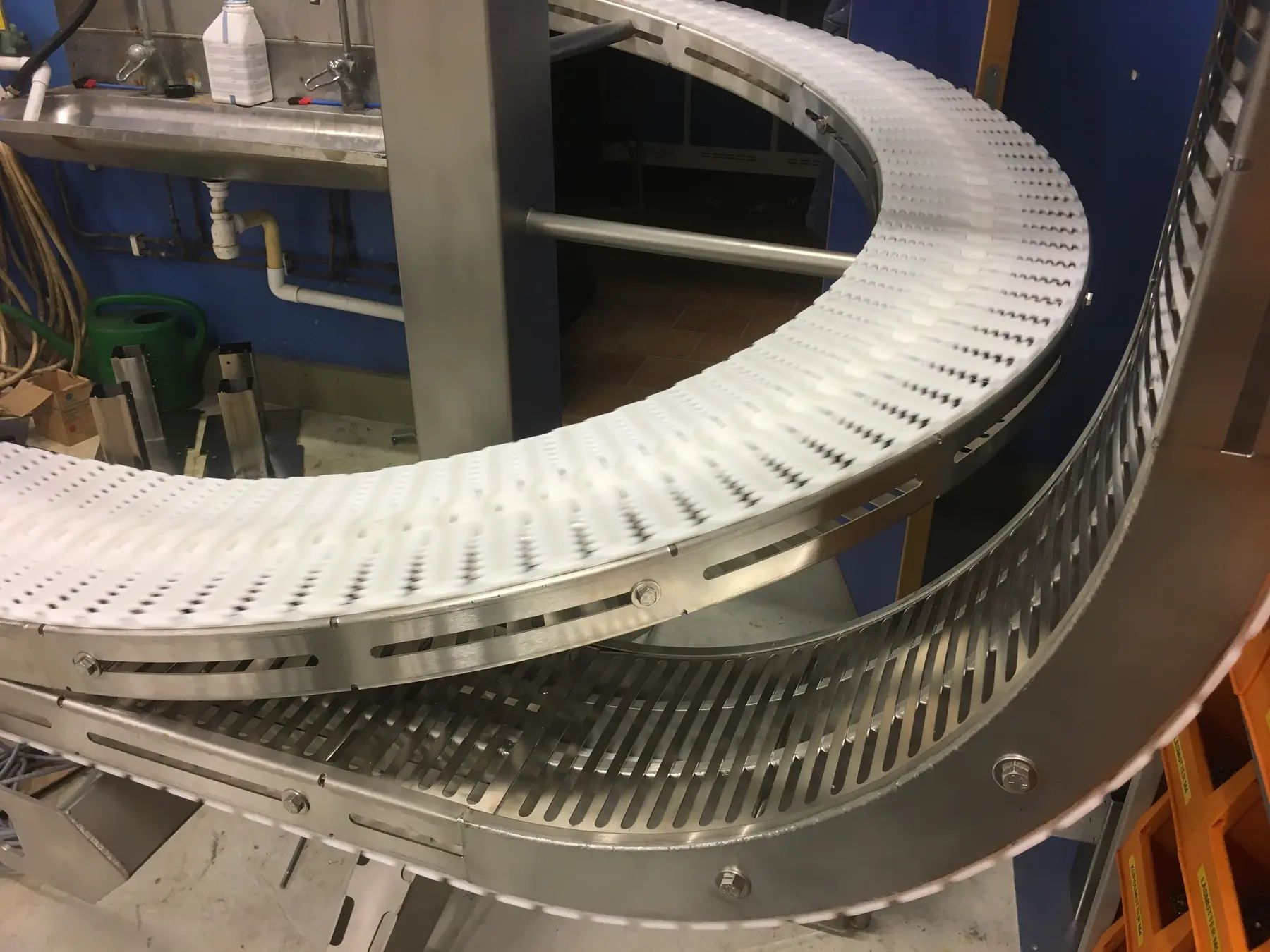
Less than you think. The 830 and 140 series have a minimum spiral centerline diameter of 2.62 feet; the 220 series is 3.9 feet. Some models fit into under three feet of manufacturing floor space.
For comparison, the dual-lane spiral we built for Matrix — one lane clockwise, one counterclockwise on a single support frame — has a spiral diameter of four feet.
Which chain width should I specify?
Plastic chains range from 24 mm to 220 mm. The standard aluminum widths are 24, 38, 62, 83, 140 and 220 mm; stainless is offered in 62, 83, 140 and 220 mm.
As a rule of thumb, the chain should be a little narrower than the product footprint, with guide rails doing the rest. Our engineers will confirm against your actual product.
Do you build the control panel too?
Yes. Our controls division designs and builds industrial control panels to UL 508A in our own panel shop, and every panel is built and tested before it ships.
We build on the platform your maintenance team already knows — Allen-Bradley / Rockwell, Siemens, Omron, Mitsubishi or Automation Direct.
Can I see the system running before it arrives?
That is exactly what our factory acceptance testing facility is for. We build the system, run it, and you come and watch it work. A fault found on our floor costs a morning; the same fault found on yours costs a shift.
What happens after installation?
We coordinate delivery, support installation and startup, train your staff, and provide service afterwards. Wear parts — chain, slide rail, cover board, guide rails, drive and idler parts — are held in stock at our 28,000 sq ft Kentucky facility.
For controls, we can fit a secure eWON VPN gateway so our engineers can troubleshoot the machine remotely without ever touching your factory network.
Do you support equipment you didn't build?
Yes. We offer technical field support for existing equipment provided by others, when and where you need it.
Can I get 3D models before I commit?
Yes, and you should. CAD models are published for every series — drop the real geometry into your layout and check the curve radii and drive positions against your floor plan before anyone quotes it.
Let's design the line around your product.
Send us your product size, throughput target and floor plan. Our engineers will come back with a layout, a footprint and a number.